Captains Log:
Hello all and salutations from UWA campus. As it is Saturday, there was no excavating done today, nor will there be any done tomorrow. The break in excitement was welcomed as we're all getting adjusted to our early schedules. The dig and various finds have been exciting, and I will touch base on those, but the greatest part so far has been the camaraderie of our small and tight-knit group.
We have our small dig-area rivalries ( Team Bakery vs. Team Palisade) but everyone is excited when anyone finds something. Most of us admitted to being hermits most of the time but field school seems to bring out the best in people.
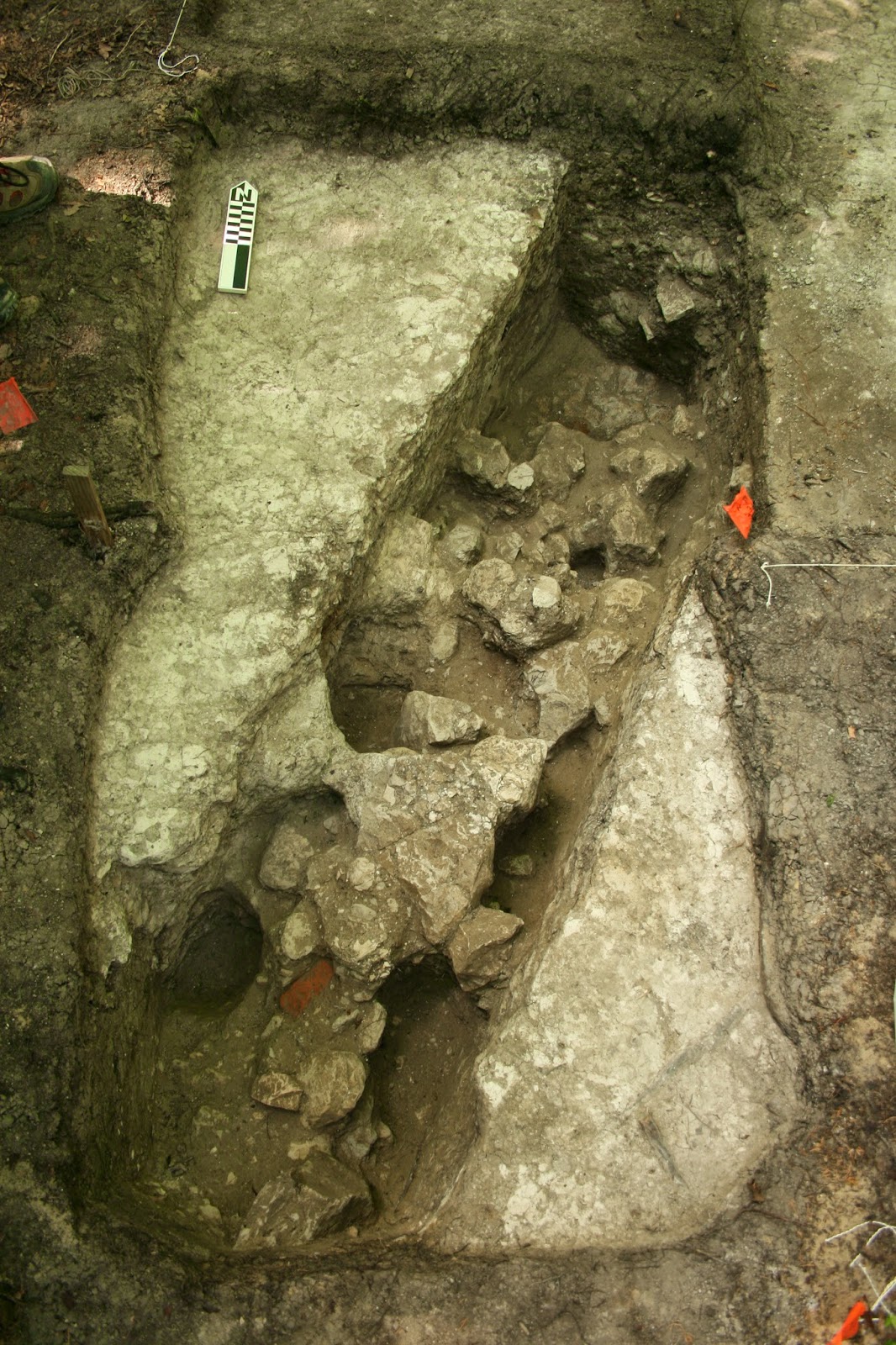
Being a weekend, I don't currently have access to the photos taken during the week; an oversight that will be rectified in my next post. We've found what we suspect to be the Northeast corner of the French bakery that was located in Fort Tombecbe, which - with our accumulation of maps and research notes - gives us a starting point for hypothesizing the footprint of the building. This is a giant discovery, because that can give us the exact location of the oven that we've been hoping to find. We've also found physical objects: glass beads (the biggest was found by yours truly), pottery shards, and pieces of glass. Hopefully next week Team Bakery can begin to get into the lower levels of our units and open up more excavation units to help complete the footprint of the French bakery.
Not a lot to report by means of excavating today, but the group has bonded well over the weekend and it is pretty apparent that everyone will keep in touch and become lifelong friends, all thanks to Fort Tombecbe.
Star Date 1014.06.24
Tingle out.
Saturday, May 24, 2014

Friday, May 23, 2014
Day 5
Today was the fifth day
of our excavation at Fort Tombecbe and the last day of our work week. Team
Bakery is still excavating the bakery area and Team Palisade is still excavating
the area in and around the wall area.
After lunch we went
around to each unit and the excavator explained what was happening in their
area. The bakery area (Team Bakery) has an interesting collection of stacked
chalk made bricks that could be the corner of the bakery. On the southern end
of the bakery area some interesting finds were made, one of which was a blue
glass bead found by B.J. This is significant because beads are a rarity here at
Fort Tombecbe, whereas in other forts they can be scattered everywhere and very
common. Natalie, in the unit next to B.J.’s, throughout the day uncovered a bunch
of nails and realized that they seemed to be in a line. B.J. then also uncovered a
nail that was in line with the ones in Natalie’s unit. As if this was not
enough, Team Bakery took the win for the day when Natalie also uncovered a
hinge. At this point all we can do is speculate what this accumulation of
artifacts means but they are tantalizing clues!
I would like to point
out that Natalie’s nails are an example of why archaeologists pull back layers
of dirt one at a time at a painstakingly slow pace. If it had been decided to
shovel through the hard chalk to where we thought there might be something we
never would have noticed the placement of the nails in a line. We would have
known they came from a general area but the placement is very helpful in
understanding that part of the site and what was going on there.
As previously stated in
another post, Lee and I opened new units in the wall area. Today I got closer
to the bottom of level A which is several inches deep and I began to uncover
small artifacts such as glass, bits of brick, animal bone fragments, and one
nail. It was interesting to find the nail on the outside of the wall and not on
the inside of the fort. Because this nail was outside of the wall and this was
somewhat unusual I had to piece plot it.
To piece plot an
artifact first you set out a folding measuring tape along the edge of your unit
so it is lined up with your marker flags. Then you measure out from the wall
how far it is into the unit. To ensure accuracy you use a plumb bob which is a
weighted and pointed tool tied to a string that you hang over your artifact to
make finding your measurement easier.
Plumb Bob

Plumb
Bob Example 1 (Not Fort Tombecbe)

Plumb
Bob Example 2

The South East corner
of my unit is part of Feature 2 which is the palisade wall and it is darker in
color and contrasts well with the surrounding chalk. The texture is also
different, the chalk is hard and when scrapped away with a trowel becomes dusty
and the Feature 2 dirt is softer and crumbles. The area around the feature is
where all of the pieces of brick, bone, and glass have been coming from.
Eleanor uncovered a
piece of pottery sticking out of the wall of her unit on the inside of the
palisade wall in an area that had different color and texture. There was
another spot like this two units over which she has begun to excavate as well. Brian
and Ron are excavating the palisade wall and found a small blue bead (I know I said
it was rare but we got lucky today). They also found a piece of hand painted
faience, white with blue paint.
Over all we have made a
lot of progress this week and have had some great finds!
Thursday, May 22, 2014
Day IV
Greetings from Fort Tombecbe, where "civilization and savagery met and the wilderness beheld the glory of France."
The first days of my first field experience have been a great one; the project family, the students and volunteers are knowledgable and hilarious.
Day four was spent in the dirt. When we arrived at the site this morning I had a full wheelbarrow of material from yesterday that I removed from a one meter by one meter unit excavated only about five centimeters deep. The water-screen was waiting for me.
Water screening is a process in which the dirt material dug out of the ground is placed on a screen and sifted through the mesh wire using water pressure to recover tiny pieces of chalk, brick, ceramic, metal, glass, bone, charcoal, clay pipe, bead, faience, etc. Today we used 1/8 inch and 1/4 inch screens to recover these tiny pieces of history. My wheelbarrow of dirt (half screened through the 1/4 inch mesh and half through the 1/8 inch mesh) yielded a gallon bag full of these little artifacts. In the westardly portion of the wall area particularly, we don't expect to find the same amount or type of artifacts that others would, as it is located outside of the fort walls. However, significant artifacts found include two pieces of triangular greenish-blue glass, bone (and part of a tooth), and red brick flecks.

At lunch we inhaled our sandwiches just a few meters away from the bluff looking out over the beautiful Tombigbee River as we laughed playing the relentless Name Game.

After fighting off the daily food coma, I returned to my section in the wall area next to the "french drain" feature. I found a few more pieces of splintered bone, specks of red brick, and plenty of chalk as I was leveling out the unit with my trowel. Ron and Brian, two meters south of me, unearthed pieces of the wooden post once at the heart of Fort Tombecbe's palisade as they finished prepping the feature for mapping and photos. Awesome!
- Light Horse
The first days of my first field experience have been a great one; the project family, the students and volunteers are knowledgable and hilarious.
Day four was spent in the dirt. When we arrived at the site this morning I had a full wheelbarrow of material from yesterday that I removed from a one meter by one meter unit excavated only about five centimeters deep. The water-screen was waiting for me.
Water screening is a process in which the dirt material dug out of the ground is placed on a screen and sifted through the mesh wire using water pressure to recover tiny pieces of chalk, brick, ceramic, metal, glass, bone, charcoal, clay pipe, bead, faience, etc. Today we used 1/8 inch and 1/4 inch screens to recover these tiny pieces of history. My wheelbarrow of dirt (half screened through the 1/4 inch mesh and half through the 1/8 inch mesh) yielded a gallon bag full of these little artifacts. In the westardly portion of the wall area particularly, we don't expect to find the same amount or type of artifacts that others would, as it is located outside of the fort walls. However, significant artifacts found include two pieces of triangular greenish-blue glass, bone (and part of a tooth), and red brick flecks.
At lunch we inhaled our sandwiches just a few meters away from the bluff looking out over the beautiful Tombigbee River as we laughed playing the relentless Name Game.
- Light Horse
Wednesday, May 21, 2014
Frogs, Chalky Chalk, and Mapping Features: Day 3
One aspect of archaeology that
often gets overlooked is the fact that we work outside and periodically find
bugs, spiders, beetles, toads and frogs inside the unit that was supposedly
secured at the end of the previous day. This morning as we were beginning work
at Team Bakery, a nice little frog joined us for a few moments before we
relocated it to a safer part of the site. After the excitement of the frog/toad
find, Team Bakery settled in for a fine morning of attempting to trowel through
thick chalk deposits. At one point, James made the comment “this is very chalky
chalk.” While it is a humorous thought and we had a good laugh, it does not
help to describe the challenges of excavating on a chalk bluff. Chalk is
alternatively very soft when it is most inconvenient, and it is extremely hard when
you find yourself wishing it was soft. The soft somewhat fragile chalk tends to
flake off in layers and leaves an interesting coating of white dust on your
shoes, hands, clothes, and face (if you’re really lucky).
 |
| Our morning visitor |
Part of
my morning was spent mapping (graphing) a small, circular deposit of Charcoal
that I noticed in my unit yesterday. Though it was small and shallow it is
still necessary to make a record of the location of the deposit. Troweling and
discovering ceramics, glass, and nails is certainly the more sexy aspect of the
work, but mapping constitutes an important, and periodically time consuming part
of the job. It is basically a process of measuring and graphing the feature for
future analytical reference. While I was busy with mapping and writing
descriptions of the feature, the rest of Team Bakery, Natalie, B.J., and James
continued work on the new units that they opened on Tuesday. It was a rather
productive day for the Team. James uncovered a nice piece of green lead glazed earthenware
and Natalie discovered a lovely sherd of faience, a tin glazed French ceramic.
 |
| Faience |
After
lunch, I started to work on what is possibly a corner of the French bakery.
This involved first scrapping away some very clayish soil while paying
particularly close attention to the amount of brick and mortar flecking. This
feature is located at the termination of a rather deep trench and in order to
best reach the area I ended up lying face down over the trench. Some of the
work was done with good old trusty Beavis the Trowel, but I also had to use a
small bamboo tool and a spoon in order to not damage the fragile mortar block
and small fragments. This is slow work and in the morning I will continue work
on this feature. A feature can be roughly defined as a non-moveable element of
an archaeological site. Unlike an artifact, a feature cannot be taken back to
the lab for later analysis which is why the process of mapping and
photographing are so important.
 |
| Mapping and chalky work shoes |
After
an amazing dinner of black-eyed peas, pickled peaches, tomato jam, homemade
mashed potatoes, biscuits and corn on the cob provided by the world’s greatest
volunteer and “camp mom” Rosa, we retired to the lab for an evening of
exploration and cleaning. Dr. Dumas shared part of the Black Belt Museum’s type
collection with us and then we worked on washing artifacts from the previous
excavation season. Washing is exactly what it sounds like: filling a small tub
with water and cleaning the artifacts with a toothbrush. After washing they are
laid out to dry on trays. We ended our evening with another frog sighting in
front our dorm rooms. It brought the day full circle: frogs, chalky chalk, and
mapping.
Tuesday, May 20, 2014
Day 2: Team Bakery vs. Team Palisade
Day 2
 |
| The Southwest Bastion |
Today was the second day of excavation at
Fort Tombecbe. As many of you reading this blog know, we are currently
excavating the palisade wall and the bakery area in the southwest bastion of
the French Fort. Today we split up into two teams, Team Bakery and Team
Palisade. Team Palisade opened two brand new excavation units and continued
work on the palisade wall. Team Bakery opened up two and a half new excavation
units and continued work on a feature previously documented.
During the many hours that I was removing dirt, I realized
three very important facts.
1)Roots are the bane of my existence.
 |
| Menacing I know |
2) There
is more dirt than you will ever imagine coming from just a few centimeters
depth.
3) If you need anything identified, lick it. Or ask Jean.
Despite the first two distressing points, today was a very
informative day as to learning how to excavate.
First, if there is grass growing on top of a unit, take the clippers and
clip them. Do not pull them up because this could ruin the context beneath.
Second, when pulling back the dirt, only take back a little bit at a time. When
you have finally removed the hummus and organic material of the top layer, then
you take a sample and assign it a color, texture, and note any disturbances in
the soil.
| Munsell or Munsell it's all the same. |
To assign color, as everybody sees colors differently, Dr.
Albert Munsell created a color system based on value, hue, and chroma. It’s
called the Munsell Color System! Anyway, take a sample and match up the colors
and that is the color of your soil. We usually refer to a page called 10YR as
that matches up most of the soil located at Fort Tombecbe.
Texture is separated into four categories: sand, silt, clay,
and loam. Sand is gritty (hint: think beach sand). Silt is powdery like flour.
Clay is sticky and can form an inch thick ribbon. Loam is a combination of
these three categories. The soil we were working with today over at Team Bakery
was actually a loamy clay like texture. It came up in clumps and is not very
fun to work with.
Once the soil is assigned its traits, then comes the serious
digging. Everything is put into buckets that are assigned a provenience, and
with provenience comes paper work. Provenience includes the site number (ISu7),
the area excavated (Wall Area/Bakery), the Unit number (e.g. 24,25, 17), the
zone number (the southwest bastion), digger’s initials, the date, and the Field Specimen number (mine was 423).
During the digging, Team Palisade (and Brian) found some
nice artifacts and features including a whole brick placed within the palisade
wall. Great job, guys!
Team Bakery, (Jean Louise, BJ, James/Boone, and me of course) mapped a feature that
needed to be redone and we also found two pieces of brick, a bone, tree roots, worms,
centipedes, and snails. We also had our
dreams and hopes crushed by nature. We found a square “gaming piece” (chalk)
and three pieces of brick (actually mineral inclusions). Hopefully we will learn more as we go deeper,.
Natalie Mooney (Team Bakery) signing out.
Day 1
Yesterday was the first day at Fort Tombecbe! Below is a
picture of our team under the flags of the three European powers that occupied
this site (not in chronological order, however):

As it was our first day, there was a lot to explain. We
started off by driving over a bridge where we were able to see the Tombigbee
River and the bluff on which the French established the fort. The river that we
see today is much bigger than the one that existed when Fort Confederation and
Fort Tombecbe operated. Although Fort Confederation was built above Fort
Tombecbe, Fort Tombecbe was much larger.
After getting to the site, we toured Fort Confederation and
the monument that was erected. Seeing the site in person helped to solidify its
importance as a buffer against the British. Its location is strategically
important because it is much further inland into the French territory. However,
it was mainly used as a trading post.
Our first job, after setting up our cap where we house tools
and gear, was to remove the sand that lay on top of the tarp, which protected
the previous excavations made in 2012. Without a doubt, the hardest
thing of a city gal like me was wielding the wheelbarrow! The picture below is
of us removing the sand from above the tarp, which is visible at the edges:

Half of us focused on the bread over area:

The other half of us addressed the area where the palisade
stood and possibly the banquette:

There is a post hole that was previously excavated and is
thought to be part of the banquette. The site is laid out in a grid pattern of
one meter squares. I was tasked to dig in the one meter square next to the one
with post hole. We are hoping that this square also contains a post hole, which
would provide us with more information in determining the location of the
banquette and its particular construction. Before we could excavate, however,
we had to remove the small vines that were growing over the previously
excavated areas.
A note on bugs: I’m used to Texas sized bugs. But Alabama,
you have some of the biggest bees and other bugs that I have ever seen!!
- Eleanor Kolb
-
Sunday, May 18, 2014
Bienvenue! Welcome! to the blog for the 2014 Archaeological Field School!
In the past two days, students have arrived in Livingston from Florida, Illinois, Texas, and around Alabama to join the project. They will spend the next four weeks learning archaeology and how to apply it to the study of the past. Although their experience is just beginning, preparations for the project have been underway for several weeks. The Black Belt Museum staff have been working at Fort Tombecbe cutting trees and brambles, surveying and setting up equipment. Screens have been repaired and tools sharpened. Keeping students and staff comfortable and well-fed are also essential for a successful project, so menus have been planned and groceries bought. The excavation itself cannot take place for the sake of excavation or solely for instructing students in methods. Archaeology, though careful and precise, does disassemble archaeological sites, each of which is unique and non-renewable. It must, therefore, proceed carefully and with well-defined goals. The overarching research goals of the Fort Tombecbe Project are to better understand what life was like for Europeans stationed there in the 18th century, the nature of their interactions with native peoples, and how each of these groups affected the other. We hope also to learn how the unique landscape and geology of the Black Belt prairie affected construction and management of Fort Tombecbe and how it compared to contemporaneous forts in the colony of La Louisiane. These goals were pursued in 2012 by excavating a portion of the palisade wall and the bakery. (See earlier posts in this blog for details.) In the 2014 season, we will complete a study of the palisade wall and bakery, focusing particularly on architectural details, and I am especially excited to extend our excavations to investigate the soldiers' barracks. In this location, we are looking for evidence of the daily lives of those stationed at the fort and hope to find artifacts of a more personal nature. I hope that you will join us by keeping up with this daily blog as written by the students who are experiencing it all firsthand.
-Ashley Dumas
In the past two days, students have arrived in Livingston from Florida, Illinois, Texas, and around Alabama to join the project. They will spend the next four weeks learning archaeology and how to apply it to the study of the past. Although their experience is just beginning, preparations for the project have been underway for several weeks. The Black Belt Museum staff have been working at Fort Tombecbe cutting trees and brambles, surveying and setting up equipment. Screens have been repaired and tools sharpened. Keeping students and staff comfortable and well-fed are also essential for a successful project, so menus have been planned and groceries bought. The excavation itself cannot take place for the sake of excavation or solely for instructing students in methods. Archaeology, though careful and precise, does disassemble archaeological sites, each of which is unique and non-renewable. It must, therefore, proceed carefully and with well-defined goals. The overarching research goals of the Fort Tombecbe Project are to better understand what life was like for Europeans stationed there in the 18th century, the nature of their interactions with native peoples, and how each of these groups affected the other. We hope also to learn how the unique landscape and geology of the Black Belt prairie affected construction and management of Fort Tombecbe and how it compared to contemporaneous forts in the colony of La Louisiane. These goals were pursued in 2012 by excavating a portion of the palisade wall and the bakery. (See earlier posts in this blog for details.) In the 2014 season, we will complete a study of the palisade wall and bakery, focusing particularly on architectural details, and I am especially excited to extend our excavations to investigate the soldiers' barracks. In this location, we are looking for evidence of the daily lives of those stationed at the fort and hope to find artifacts of a more personal nature. I hope that you will join us by keeping up with this daily blog as written by the students who are experiencing it all firsthand.
-Ashley Dumas
Subscribe to:
Posts (Atom)